Publications
Morphing structures with tunable stiffness
-
Scale-inspired programmable robotic structures with concurrent shape morphing and stiffness variation
Science Robotics 9, eadl0307 (2024)
A structure inspired by fish and pangolin scales takes a designed shape as it stiffens under vacuum, used in an amphibious robot and drone landing gear.
-
Design and modeling of a programmable morphing structure with variable stiffness capability
International Journal of Mechanical Sciences 284, 109699 (2024)
Geometric analysis and simulations give design rules for a scale structure: friction above a threshold hinders morphing, and reshaping the scales’ surface eases the trade-off between morphing and stiffening.
- Co-authored
-
Suture-inspired interlocking metamaterials for energy-efficient morphing
Advanced Functional Materials 36, e78343 (2026)
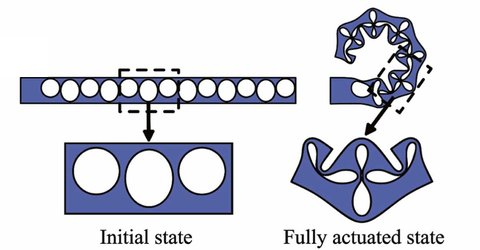
Bistable joints modeled on natural sutures let metamaterials built from particles morph and then hold their shape under load without continuous actuation.
-
Thermally responsive architected actuators with programmable shape morphing and tunable stiffness
Advanced Intelligent Systems 7, 2500123 (2025)
Tessellated particles joined by shape memory alloy springs change shape and stiffen together when heated electrically.
-
Negative-pressure soft pneumatic actuators enabled by asymmetrically distributed bending units
Extreme Mechanics Letters 77, 102340 (2025)
Silicone actuators bend under vacuum in directions set by the layout of their holes, and drive grippers and a crawling robot.
-
Multistable soft robots assembled from bistable auxetic building blocks
Advanced Intelligent Systems 7, 2400529 (2025)
Building blocks that snap between two stable shapes form a robot arm and a tube crawler that hold their shapes when the air supply is cut.
-
Active Fabrics With Controllable Stiffness for Robotic Assistive Interfaces
Advanced Materials 36, 2404502 (2024)
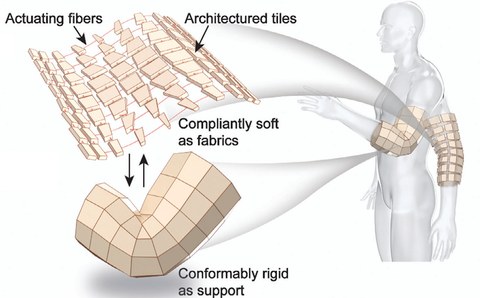
Rigid tiles linked by actuated fibers form fabrics that switch from soft to stiff around the body, for exosuits and body armor.
-
Hierarchical tessellation enables programmable morphing matter
Matter 7, 603–619 (2024)
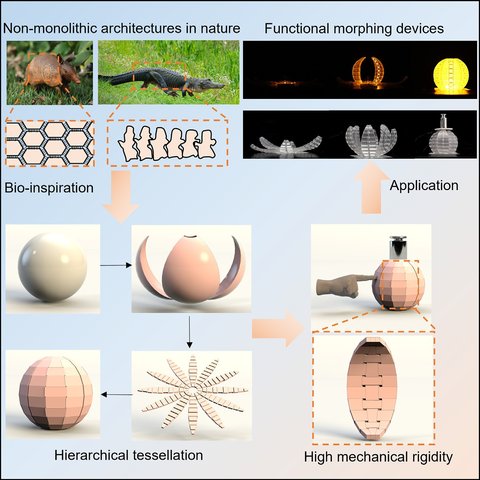
A design method divides a curved 3D surface into rigid particles laid out flat, which tendons pull into that shape with tunable stiffness.
-
Tunable mechanics of architectured composites from particle assemblies
Extreme Mechanics Letters 67, 102121 (2024)
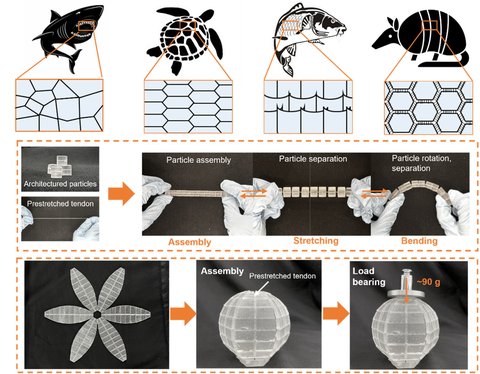
Rigid particles held by prestressed soft ligaments form beams whose bending load capacity is set by particle shape and prestress, and can be tuned by electrical heating.
-
Self-sensing robotic structures from architectured particle assemblies
Advanced Intelligent Systems 5, 2200250 (2023)
Rigid particles sealed in a rubber envelope form structures that change shape and stiffen under vacuum, and sense their own deformation through conductive coatings.
Robot control, sensing and wearables
-
Muscle coactivation-inspired stiffness-driven control strategy for antagonistic soft robots
Science Advances 12, eaeg3346 (2026)
A data-driven controller, inspired by how opposing muscles tense together, learns in minutes to control the motion and stiffness of robots driven by opposing actuators.
- Co-authored
-
Flexible multichannel muscle impedance sensors for collaborative human-machine interfaces
Science Advances 11, eadv3359 (2025)
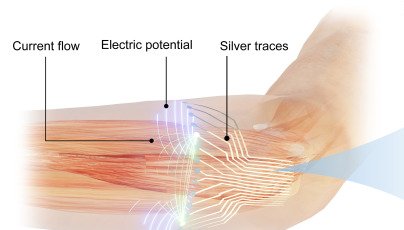
A thin, soft impedance sensor that conforms to skin reads the contractions of several deep muscles, for gesture recognition, force prediction, human-robot collaboration and exoskeleton control.
-
High-efficiency single-droplet energy harvester for self-sustainable environmental intelligent networks
Advanced Energy Materials 13, 2302858 (2023)
A droplet energy generator coated on a recycled DVD turns single falling droplets into electricity for self-powered environmental sensors.
-
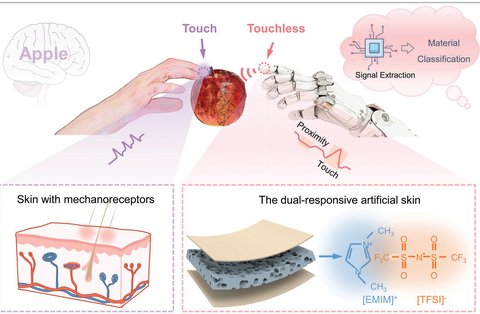
A dual-responsive artificial skin for tactile and touchless interfaces
Small 19, 2206830 (2023)
A flexible capacitive skin senses both touch pressure and approaching objects, and can tell metals, polymers and human skin apart before contact.

Mechanics of gradient nanograined metals and thin films
-
Modelling the Shear Banding in Gradient Nano-Grained Metals
Nanomaterials 11, 2468 (2021)
A computational model of gradient nanograined copper shows that its coarse-grained core makes shear bands form early and multiply at the surface, explaining its ductility.
-
Shear band multiplication induced strong strain delocalization and high tensile ductility in amorphous thin films by metallic substrates
International Journal of Solids and Structures 195, 1–12 (2020)
Simulations show that a metal substrate makes a thin metallic glass film form many shear bands instead of one, which raises its tensile ductility.
-
Tailoring tensile ductility of thin film by grain size graded substrates
International Journal of Solids and Structures 166, 124–134 (2019)
Simulations show that a substrate whose grains coarsen with depth can let a thin film stretch further before necking than a uniform coarse-grained substrate does.
- Co-authored
-
Computational modelling of frictional deformation of bimodal nanograined metals
International Journal of Mechanical Sciences 222, 107220 (2022)
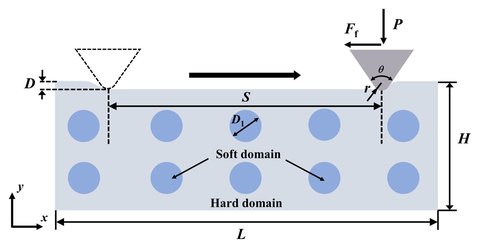
Finite element scratch tests show why bimodal nanograined copper has lower friction than uniform copper: its mixed grain sizes restrain strain localization.
-
Enhanced frictional performance in gradient nanostructures by strain delocalization
International Journal of Mechanical Sciences 201, 106458 (2021)
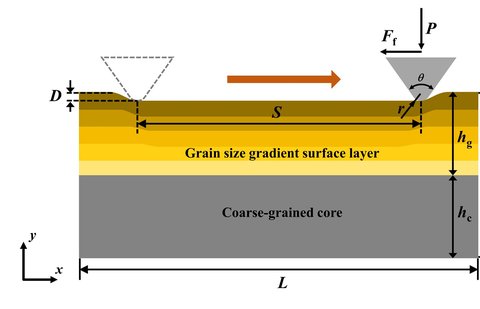
Finite element scratch tests show that gradient nanograined copper has lower friction because its layers deform together and spread the strain.
-
Eliminating deformation incompatibility in composites by gradient nanolayer architectures
Scientific Reports 8, 16216 (2018)
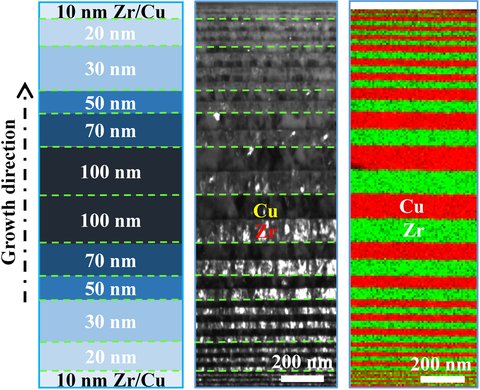
Copper–zirconium nanolayers with graded spacing deform compatibly in micropillar compression, removing the mismatch between their soft and hard layers.